Okay, I was nearing 10. Some might say that’s old enough, but I have a perspective worth sharing.
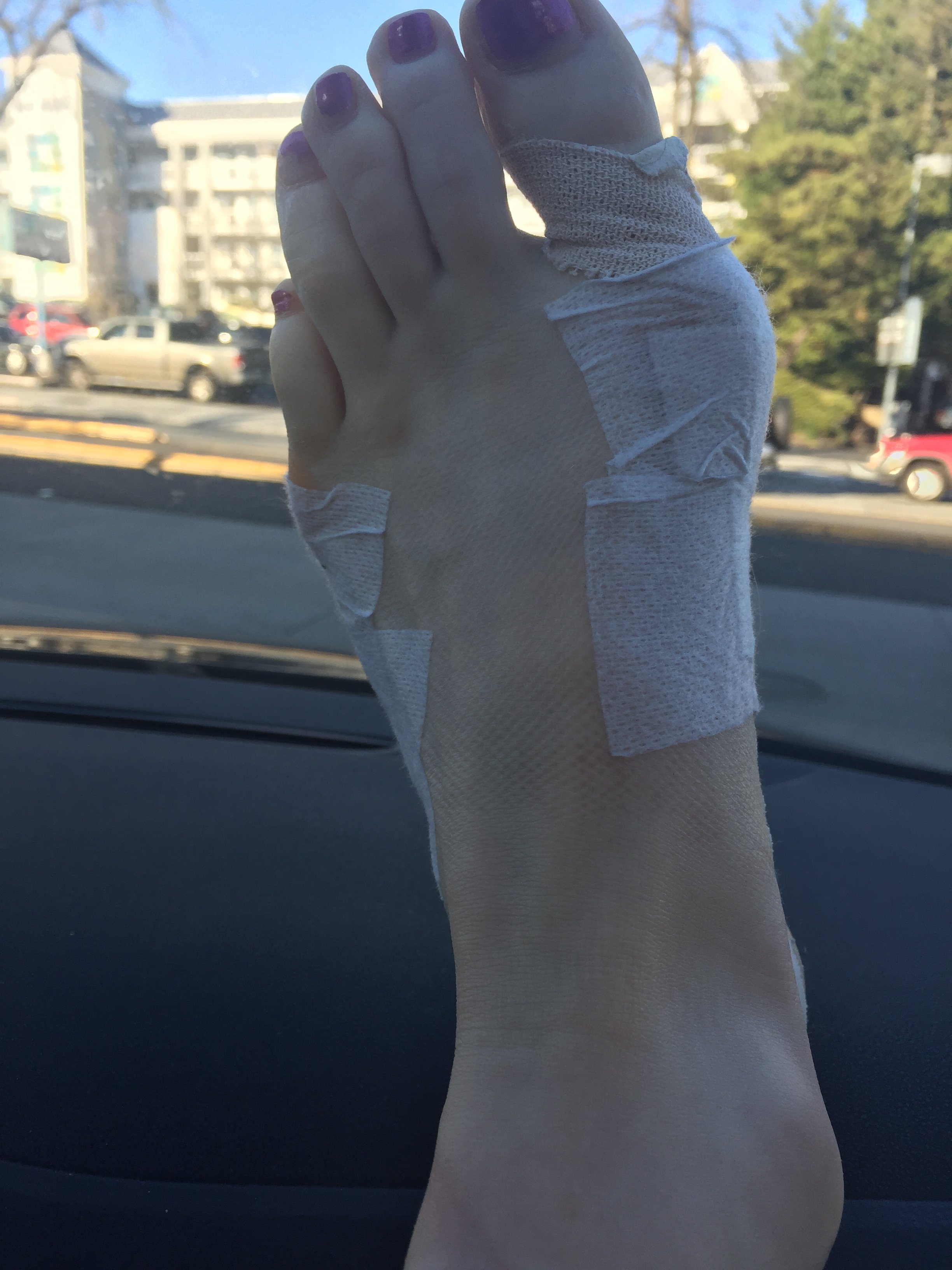
Bunion taped up in my car outside doctor’s office after fracturing my sesamoid bone in rehearsal.
The foot is your base of support, dictating the alignment of all the joints above it. When you’re 9 or 10 years old, your bones are still cartilaginous and malleable and likely lacking sufficient support from the intrinsic musculature surrounding them. Add in the statistic first uncovered by physical therapist Jarmo Ahonen for the Journal of Dance Medicine & Science in 2008: pointework adds a force 12x your body weight through the toes.
I likely already had a genetic predisposition to bunions, and didn’t know it. My parents don’t have them, but it could’ve skipped a generation. Or maybe my malformed big toe joints are simply due to pointe. It’s a question no doctor can truly answer with certainly, but usually the consensus is that it’s at least partially genetic.
I don’t remember a time when I didn’t have bunions, but I do know that they formed quickly after starting pointe; maybe age 12 or 13. This is around the time the foot reaches some sort of structural maturity. I still wonder to this day if my feet would be any different had I waited until I was 13 to start pointe.
I do know with absolute confidence that when I started pointe, the strength of my feet, hips, and core was substantially underdeveloped. I wasn’t educated about alignment or conditioning for ballet or pointe, but I’m really pleased to see today’s students and parents so much more in tune to these important concepts.

Breaking in pointe shoes for Carmina Burana backstage, and realizing how large my bunions have become at this point…
At the same time I started my pointe journey, I also found out I had a slight curve in my spine at a school screening. It wasn’t enough to put me in a brace or cause me major issues, but what they failed to tell me was that it can cause minor shifts in posture that place cumulative wear and tear on the joints.
Pointework with these factors— a predisposition to bunions, spinal abnormalities, hypermobility, and late growth (I was tiny until about 15 and finished growing at 21)— without proper strength is a recipe for disaster. You are altering your skeleton’s structure and alignment in a vulnerable growth period, permanently affecting your body (in both bad but also good ways!).
This isn’t meant to be a persuasive essay arguing NOT to ever dance en pointe. In fact, when I had an X-ray done on my foot after 15 years of pointe, my doctor noticed my metatarsals were much thicker (stronger) than those of the average human. I think that’s pretty awesome! The body is extremely adaptable and stress is critical to developing strength and resilience for your life. I could go on about how important it is for girls and women to build bone mass in young adulthood— hint: allegro and (clearly) pointework is amazing at doing just that!
I just think it’s critical to get educated on basic anatomy and biomechanics, and to develop lumbopelvic stability, proprioception, and the intrinsic muscles of the feet. And don’t leave out the rib cage, breath, and scapulae— if we don’t work on promoting neutral alignment for the entire body, we won’t see nearly as much progress in developing functional strength for pointework. Once you discover how connected the body really is, you’ll realize that you can’t just do a few foot exercises and become an excellent pointe dancer. At least, not without pain, injury… and maybe bunions!
Whether you’re not yet en pointe, or you’ve been on your toes for 10 years, reach out to discuss how we can improve your alignment and strength!
