And I didn’t discover it until I was in my pre-professional program.
Mat Pilates was quite familiar to me, however it varied in terms of focus and rigor. I’m pretty sure my first exposure was as a 7 year old following along to my parents’ Gaiam-brand DvDs (and I realize that admission likely ages me). I think those videos were actually quite good.
Later on, at about 11 or 12, my ballet school started offering occasional mat and floor barre classes. I enjoyed these but I understood very little about the concepts behind the lessons. I remember being 12 or 13 and hearing the words “pelvic floor” and “diaphragm” for the first time, as I lay on my mat trying so desperately to visualize these bowl-shaped muscular references that are so crucial to core engagement and breath. Also why do we have to talk about breath— doesn’t it just happen naturally?
I remember wondering when the work would actually begin, as in those legendary DvDs that had you in the Hundred by minute five. In this mat class, I was lying on my back, eyes closed, hearing about the transversus abdominus again for the 4th Thursday in a row.
While I was thrilled to kind of zen out this hour rather than rehearse Nutcracker in pointe shoes, it felt like a total waste of time. I didn’t know what she was talking about and I didn’t come close to breaking a sweat. Maybe Pilates isn’t that great after all, I thought.
Realistically, the information presented was incredibly useful, but I was too young to comprehend such foreign concepts. If I’d had a visual anatomy lesson, the outcome might have been a bit better. And this is the understanding I’m taking with me as I embark on my career as an advanced Pilates instructor for young dancers and athletes.
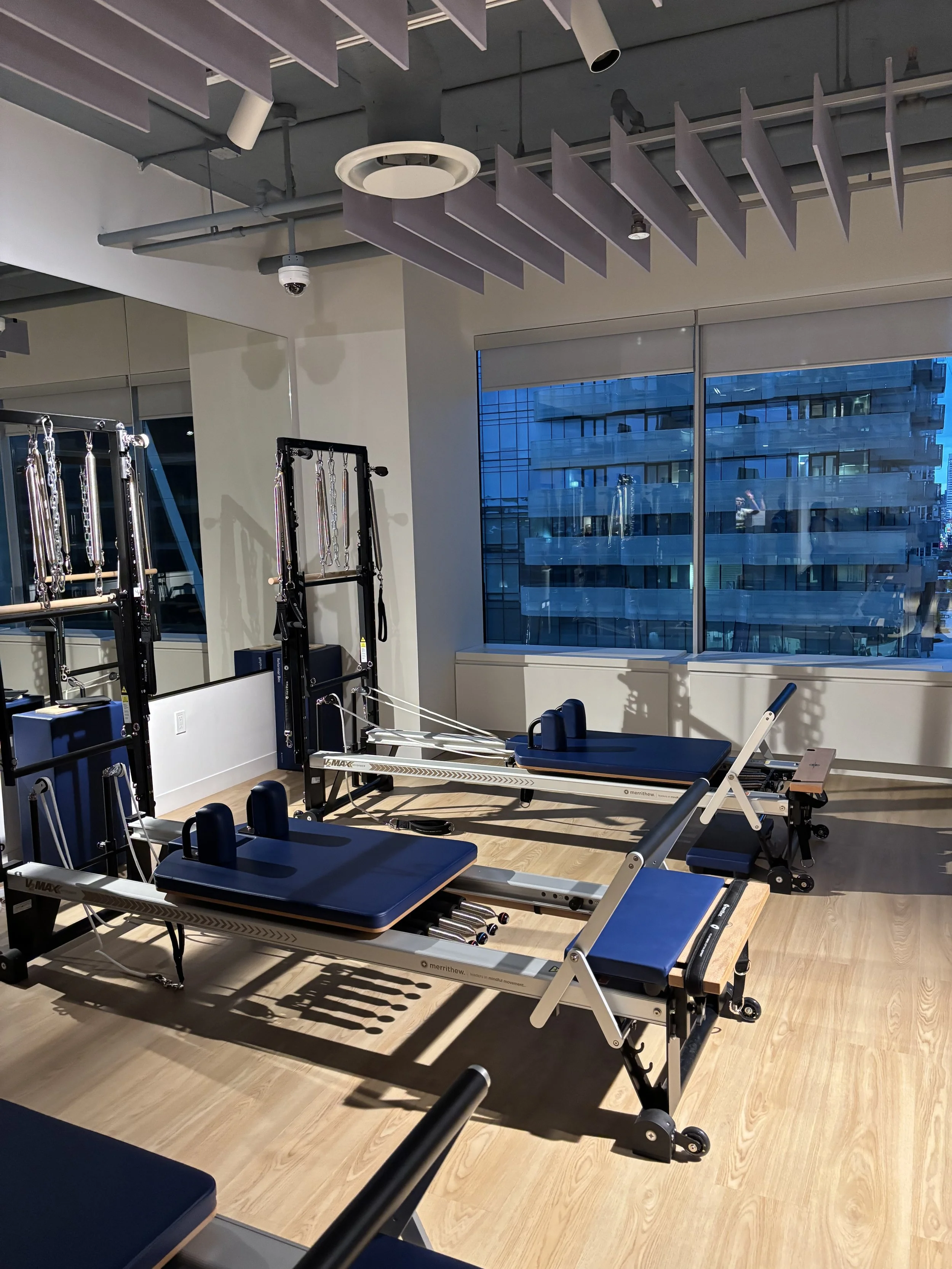
Once I became a Professional Division student, I gained access to an entire Pilates program incorporating the Reformer, Cadillac, Chair and Barrels. We were able to sign up for small group Reformer classes, where we actually started intelligently engaging the deepest muscles of the core using our breath. Exactly what my previous instructor talked about, but now, on the Refomer, I was embodying the concept.
When I suffered my first major injury, a fracture of one of my big toe’s sesamoid bones (basically the tiniest bone you can fracture), I took to the Reformer even more. I discovered new ways of continuing my progress as a dancer by modifying moves to take pressure off that toe without losing form.
I could still press the Reformer out against my heels, which actually aids engagement of the posterior chain (glutes, hamstrings) even more. I did tons of feet in straps, working my abductors and adductors more than I’d ever in my life. When I was further along in my recovery, I started jumping with such little impact to my bones that I didn’t feel that big toe flare up at all.
My foot was broken, but the rest of my body wasn’t, and I wisely used that time to strengthen up the chain. When I returned to Sleeping Beauty rehearsals I was able to balance on that foot in arabesque (Nymphs… iykyk) with no pain and total stability. Even more than some dancers that hadn’t spent the last 6 weeks out of ballet.
The Reformer is a serious student’s most valuable tool, and just as critical is having an instructor that can guide you, whether you’re preparing for competition, or recovering from injury. Please reach out to me to discuss options for booking your introductory session!
